


“W
Signos grabados en conchas de tortuga de 8,600 años de antigüedad ( 6.600 a.C.) hallados en China en contexto Neolítico parecen encontrarse entre los más antiguos del mundo, según los arqueólogos.
Son anteriores a los mesopotámicos en máss de 2.000 años y muy parecidos a los usados en China durante la Dinastía Shang , h. 1700-1100 a.C

Signos arcaicos sumerios h.3200 .C.
El hallazgo ha sido calificado de anómalo . Los arqueólogos hallaron 11 signos separados en las conchas de tortuga y restos humanos en 24 tumbas neolíticas en Jiahu en la provincia de Henan , al oeste de China, un acimiento datado con C14 entre 6.600 - 6.200 a.C..
The research was carried out by Dr Garman Harbottle, of the Brookhaven National Laboratory in New York, US, and a team of archaeologists at the University of Science and Technology of China, in Anhui province.
“What [the markings] appear to show are meaningful signs that have a correspondence with ancient Chinese writing,” said Dr Harbottle.
The Neolithic markings include symbols that resemble the characters for “eye” and “window” and the numerals eight and 20 in the Shang script.
“If you pick up a bottle with a skull and crossbones on it, you know instantly that it’s poison without the word being spelt out. We’re used to signs that convey concepts and I wouldn’t be surprised if that’s what we’re seeing here,” Dr Harbottle told BBC News Online.
However, Professor David Keightley, of the University of California, Berkeley, US, urged caution, particularly over the proposed link to the much later Shang script.
“There is a gap of about 5,000 years [between them]. It seems astonishing that they would be connected,” he said.
He added that the link had to be proved more thoroughly.
But Dr Harbottle points to the persistence of sign use at different sites along the Yellow River throughout the Neolithic and up to the Shang period, when a complex writing system appears.
hat [the markings] appear to show are meaningful signs that have a correspondence with ancient Chinese writing,” said Dr Harbottle.
The Neolithic markings include symbols that resemble the characters for “eye” and “window” and the numerals eight and 20 in the Shang script.
“If you pick up a bottle with a skull and crossbones on it, you know instantly that it’s poison without the word being spelt out. We’re used to signs that convey concepts and I wouldn’t be surprised if that’s what we’re seeing here,” Dr Harbottle told BBC News Online.
|
|
However, Professor David Keightley, of the University of California, Berkeley, US, urged caution, particularly over the proposed link to the much later Shang script.
“There is a gap of about 5,000 years [between them]. It seems astonishing that they would be connected,” he said.
He added that the link had to be proved more thoroughly.
But Dr Harbottle points to the persistence of sign use at different sites along the Yellow River throughout the Neolithic and up to the Shang period, when a complex writing system appears.
He emphasised that he was not suggesting the Neolithic symbols had the same meanings as Shang characters they resembled.
Professor Keightley added: “It’s a puzzle and an anomaly; [the symbols] are remarkably early. We can’t call it writing until we have more evidence.”
Shaman rituals
He noted that there were indications the Neolithic culture at Jiahu may not have been complex enough to require a writing system.
But Professor Keightley did say the signs appeared to be highly “schematised” or stylised. This is a feature of Chinese written characters.
|
|
Aggregations of small pebbles were found close to several of the tortoise shells.
The Jiahu researchers propose that the shells once contained the pebbles and were used as musical rattles in shamanistic rituals.
In one grave, eight sets of tortoise shells were placed above the skeletal remains of a man whose head was missing.
The shells come from graves where, in 1999, the researchers unearthed ancient bone flutes. These flutes are the earliest musical instruments known to date.
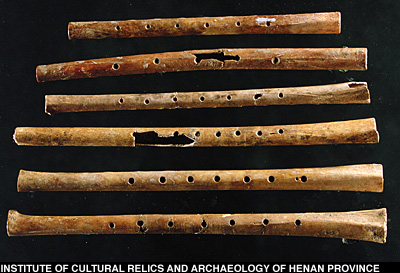
Bone flutes, second oldest known instruments, the oldest are Neanderthal.
Archivado en: ACTUALIDAD, Arqueologia
Trackback Uri
 Cargando ...